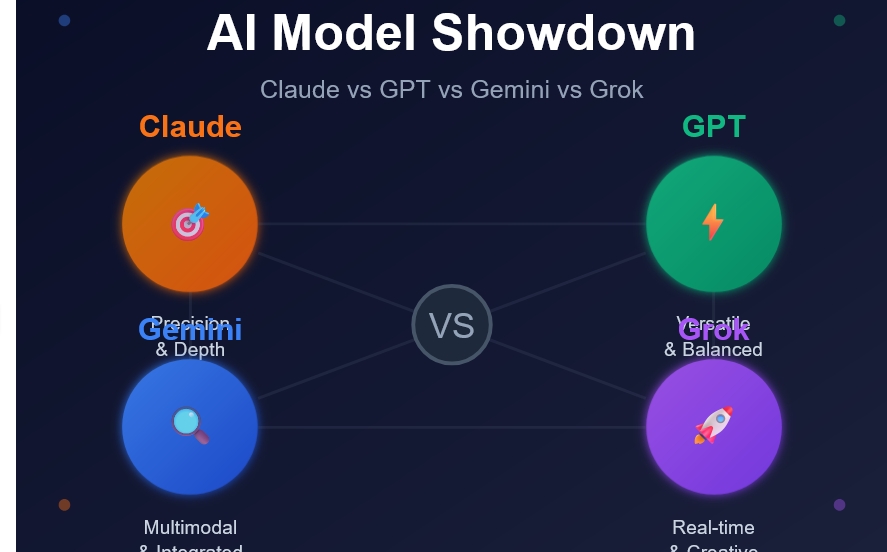
The landscape of artificial intelligence has rapidly evolved from a single-player game into a competitive arena featuring multiple world-class large language models (LLMs). For developers, writers, researchers, and creative professionals, this abundance creates both opportunity and confusion. Claude, GPT, Gemini, and Grok each represent cutting-edge AI capabilities, yet they differ significantly in their strengths, personalities, and optimal use cases. Understanding these distinctions isn’t merely academic—it’s essential for maximizing productivity and achieving superior results in your work.
The central thesis of this essay is straightforward: there is no universally “best” AI model. Rather, excellence emerges from strategic matching between task requirements and model capabilities. Just as a carpenter wouldn’t use a hammer for every job, developers and creative professionals shouldn’t default to a single AI for every challenge. By understanding what each model does exceptionally well, you can assemble a powerful toolkit that leverages the right intelligence for each specific situation.
Claude: The Meticulous Craftsman
Anthropic’s Claude has earned its reputation as the developer’s choice for complex, nuanced work requiring exceptional precision and extended reasoning. When you’re deep in a challenging debugging session, wrestling with architectural decisions, or interpreting dense technical documentation, Claude’s meticulous approach shines brightest.
What sets Claude apart is its combination of coding excellence and ethical design principles. The model excels at maintaining context over long conversations, allowing you to work through intricate problems without constantly re-explaining background information. This makes Claude particularly valuable for refactoring legacy code, where understanding the existing system’s logic and constraints is just as important as writing new code.
Claude’s performance on coding benchmarks like SWE-bench—which evaluates models on real-world software engineering tasks—frequently places it at the top of leaderboards. But beyond raw capability, Claude’s personality matters. It approaches problems methodically, asks clarifying questions when ambiguity exists, and demonstrates strong reasoning about trade-offs. When you need an AI that won’t rush to solutions but will thoughtfully consider implications, Claude delivers.
The model’s strength with long contexts means you can paste entire configuration files, multiple related code modules, or comprehensive documentation and receive analysis that accounts for all the details. For work requiring high precision—security-critical code, complex algorithms, or systems where subtle bugs could have serious consequences—Claude’s careful, safety-conscious approach provides reassurance.
GPT: The Versatile Generalist
OpenAI’s GPT family, particularly the latest iterations like GPT-4 and the anticipated GPT-5, represents the balanced, general-purpose option that handles the broadest range of tasks competently. If Claude is the specialist surgeon, GPT is the experienced general practitioner—capable across domains and refined through extensive real-world usage.
GPT’s greatest strength lies in its versatility combined with an ecosystem of developer tools and integrations. The model performs admirably across coding, creative writing, analysis, brainstorming, and conversation. This makes it the natural choice when you need a single AI capable of moving fluidly between different types of work throughout your day.
For software prototyping and rapid development, GPT offers an excellent balance of speed and capability. The model can quickly scaffold applications, generate boilerplate code, suggest architectural patterns, and explain unfamiliar libraries. Its integration with tools like GitHub Copilot brings AI assistance directly into developer workflows, reducing context switching and maintaining flow state.
What makes GPT particularly compelling is its state-of-the-art performance across metrics. OpenAI’s continuous refinement means the model stays competitive on coding benchmarks while also excelling at tasks like mathematical reasoning, creative writing, and nuanced conversation. For teams or individuals who want to standardize on a single AI platform, GPT’s well-roundedness makes it the safe choice.
The model’s extensive training on diverse datasets also means it brings broad knowledge to problems. Whether you’re working with a mainstream framework or an obscure library, GPT likely has relevant training data to draw upon. This breadth complements its depth, making it genuinely useful across the full spectrum of development challenges.
Gemini: The Data-Driven Integrator
Google’s Gemini represents a different value proposition: deep integration with the world’s information infrastructure combined with impressive multimodal capabilities. When your work involves analyzing images alongside code, requires access to current information, or benefits from tight integration with Google’s ecosystem, Gemini deserves serious consideration.
The model’s massive context window—up to one million tokens in certain configurations—enables analysis of truly enormous codebases. You can feed Gemini entire projects and ask questions that require understanding how distant components interact. For code reviews, documentation generation, or understanding unfamiliar systems, this extended context provides genuine utility.
Gemini’s multimodal capabilities distinguish it from text-focused competitors. The model can analyze UI screenshots and generate corresponding code, review architectural diagrams and suggest improvements, or examine data visualizations and recommend optimizations. This vision-language integration creates workflows impossible with text-only models.
Integration with Google Search means Gemini can access current information, making it valuable for tasks requiring up-to-date knowledge about frameworks, libraries, or best practices. The connection to Google Workspace enables workflows where AI assists directly with documents, spreadsheets, and presentations. For organizations already invested in Google’s ecosystem, these integrations provide substantial productivity gains.
From a cost-efficiency perspective, Gemini often delivers strong performance at competitive pricing. Google’s infrastructure advantages translate into good value, particularly for high-volume usage. The various Gemini models—from the lightning-fast Flash to the more capable Pro—allow optimization for specific speed-versus-capability trade-offs.
Grok: The Real-Time Maverick
xAI’s Grok occupies a unique niche in the LLM landscape, distinguished by real-time data access, social media integration, and a personality that breaks from the corporate-safe tone of competitors. While perhaps less polished for traditional coding tasks, Grok excels in scenarios requiring current information, trend awareness, and creative, unconventional thinking.
Grok’s connection to real-time data, particularly from X (formerly Twitter), makes it invaluable for understanding current events, emerging trends, and public sentiment. For developers building social applications, analyzing viral content, or staying current with rapidly evolving tech conversations, this real-time awareness provides competitive advantage.
The model’s personality—more direct, humorous, and willing to engage with edgy content—appeals to users tired of overly cautious AI responses. This doesn’t mean Grok lacks capability; rather, it approaches problems with a different style. For creative brainstorming, generating unconventional solutions, or “vibe coding” where personality and energy matter, Grok’s unique character adds value.
Grok’s willingness to engage with topics other models might deflect or hedge on can be genuinely useful. When you need straightforward answers without diplomatic hedging, or want an AI that matches your direct communication style, Grok delivers. This makes it particularly appealing for experienced developers who value efficiency over hand-holding.
For quick iterations, experimental code, or creative content generation, Grok provides a refreshing alternative to more formal AI assistants. While it might not be your first choice for mission-critical systems, it excels at the exploratory, playful work that often precedes serious development.
Strategic Selection: Matching Model to Task
Understanding each model’s strengths enables strategic selection based on task characteristics. This decision framework helps optimize your AI toolkit:
For complex, high-stakes coding projects requiring extended reasoning: Claude’s meticulous approach, strong performance on software engineering benchmarks, and careful consideration of edge cases make it the natural choice. When correctness matters more than speed, Claude delivers.
For general-purpose development work spanning multiple domains: GPT’s versatility, extensive tooling integration, and balanced performance across tasks make it ideal. When you need one AI to handle diverse responsibilities throughout your workday, GPT’s breadth excels.
For multimodal projects involving images, diagrams, and massive codebases: Gemini’s vision capabilities, enormous context window, and Google ecosystem integration provide unique advantages. When your work crosses modalities or requires analyzing huge systems, Gemini’s specialized strengths justify its use.
For real-time information, trend analysis, and creative experimentation: Grok’s live data access, social integration, and distinctive personality offer capabilities unavailable elsewhere. When timeliness and unconventional thinking matter, Grok fills a valuable niche.
The Context Window Consideration
Context window size—how much text a model can consider simultaneously—represents a crucial technical differentiator. Gemini’s million-token context enables analysis of entire large projects. GPT and Grok offer substantial windows suitable for most development tasks. Claude, while having a large context window, particularly excels at maintaining coherent reasoning across long conversations.
For most daily coding tasks, any of these models provides sufficient context. The differences matter most when working with very large codebases, extensive documentation, or long debugging sessions. Understanding your typical context requirements helps guide model selection.
Performance Trade-offs: Speed Versus Depth
Different models optimize for different points on the speed-versus-capability spectrum. Faster models like Gemini Flash or certain GPT configurations provide quick responses ideal for rapid prototyping or interactive development. Deeper models like Claude Opus invest more computation in complex reasoning, justifying the additional latency when problem difficulty demands it.
Savvy developers often maintain access to multiple models, selecting based on immediate needs. Quick syntax questions and boilerplate generation work well with faster models. Architectural decisions, complex debugging, and security-critical code benefit from deeper analysis despite longer response times.
The Multi-Model Strategy
Increasingly, sophisticated users adopt multi-model strategies, leveraging different AIs for different aspects of their workflow. This approach maximizes the unique strengths of each platform while mitigating individual weaknesses.
A typical multi-model workflow might use Claude for core development work requiring careful reasoning, GPT for general assistance and quick questions throughout the day, Gemini for analyzing design mockups or reviewing large codebases, and Grok for staying current with tech trends and generating creative content.
This diversification provides resilience—when one model struggles with a particular task, alternatives exist. It also enables comparative analysis, where asking multiple AIs the same question reveals different perspectives and approaches.
The Future Trajectory
The competitive LLM landscape ensures rapid advancement. Each major player continuously releases improved models, expands capabilities, and refines performance. Today’s strategic recommendations will evolve as models advance, but the fundamental principle endures: matching tool to task yields superior results.
We’re moving toward a future where AI capabilities become increasingly specialized and differentiated rather than converging on identical feature sets. Understanding these distinctions and making thoughtful choices amplifies your effectiveness far beyond defaulting to whichever model you encountered first.
Conclusion: The Strategic Imperative
In an era where AI assistance has become essential to knowledge work, treating all LLMs as interchangeable represents a costly mistake. Claude, GPT, Gemini, and Grok each embody different design philosophies, optimization targets, and capability profiles. Excellence emerges not from identifying a single “best” option, but from understanding when each tool provides maximum advantage.
For developers, this means building a strategic AI toolkit: Claude for complex reasoning and high-precision coding, GPT for balanced general-purpose work, Gemini for multimodal and data-rich projects, and Grok for real-time information and creative exploration. The investment in understanding these distinctions pays dividends through improved productivity, higher-quality outputs, and more elegant solutions.
The question isn’t “Which AI is best?” but rather “Which AI best serves this specific need?” Answering that question thoughtfully, task by task, transforms AI from a generic assistant into a finely-tuned instrument for professional excellence. In the competitive landscape of modern software development and creative work, this strategic sophistication increasingly separates those who merely use AI from those who master it.